I. Industry Background and Market Demand
As global industrial technology undergoes accelerated iteration, the demand for automotive lightweighting, high reliability in the aerospace sector, and the ability of energy equipment to withstand extreme environments has been continuously on the rise. This has led to increasingly stringent requirements for the material properties, machining accuracy, and environmental adaptability of castings and forgings. According to data from McKinsey's White Paper,
- 78% of enterprises experience production delays due to design flaws, with an average loss accounting for 15% to 20% of the project budget.
- 63% of customers view "process optimization" as the core means of reducing total costs.
- In the high-end equipment sector, the demand for fatigue life, corrosion resistance, and impact resistance of castings and forgings grows at an average annual rate of 12%.
Against this backdrop, technology-oriented customers are placing greater emphasis on the collaborative optimization of the entire "design-process-cost" chain. By introducing external professional technical support, they aim to shorten research and development (R&D) cycles and enhance product competitiveness.

II. Customer Pain Points and R&D Challenges
Customer Background: The globally leading energy equipment manufacturer specializing in the R&D of key components such as high-pressure vessels and nuclear power valves.
Core Requirements: A certain model of metal seal designed by client needs to operate stably over the long term in extreme temperatures ranging from -40°C to 150°C and in strongly corrosive media. However, the prototype has encountered issues such as cracking and seal failure, posing a risk of project delays.
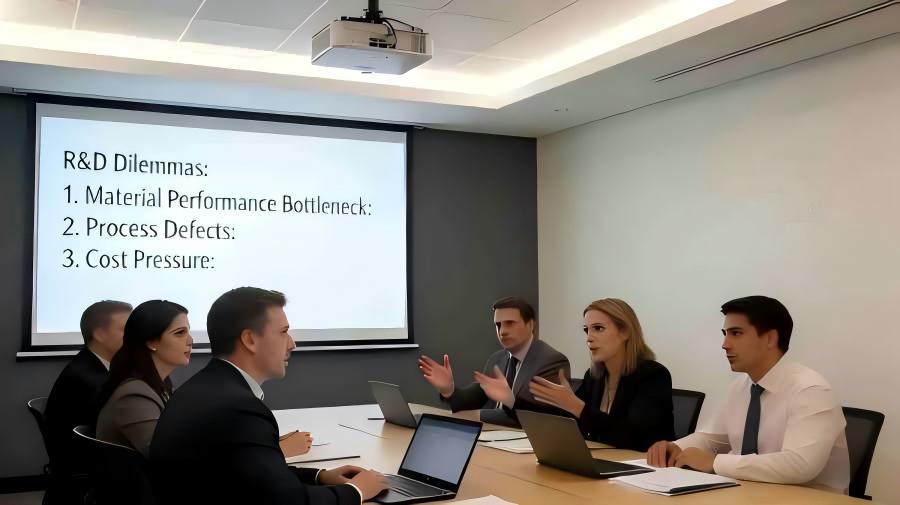
R&D Dilemmas:
- Material Performance Bottleneck: The prototype uses traditional alloys, which lack sufficient low-temperature toughness.
- Process Defects: Deviations in the temperature control during the forging heating process caused strength reduction accompanied by grain coarsening in the material.
- Cost Pressure: Quality loss costs account for 25% of the total costs, necessitating a reduction in the scrap rate through process optimization.
III. Technical Analysis Model and Optimization Path
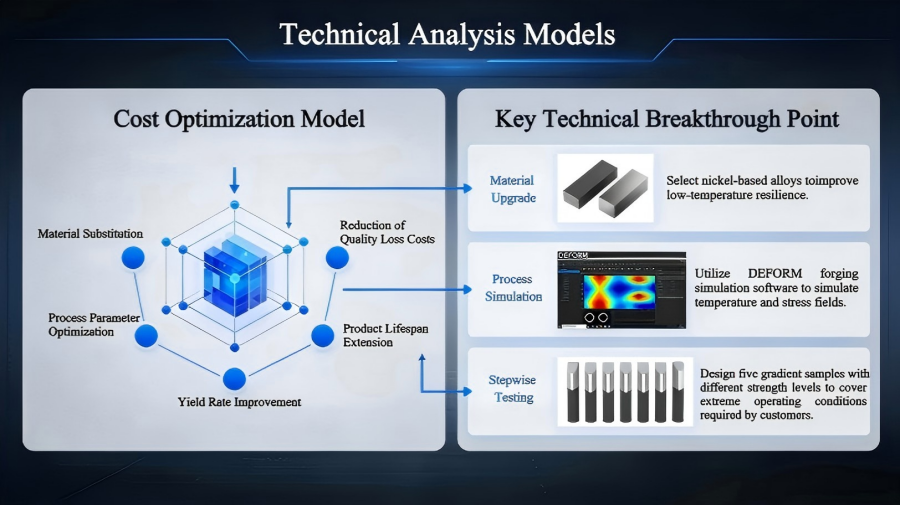
Total Cost Model
Based on the Design for Manufacturing/Assembly (DFM/DFA) concept, a dynamic cost analysis framework is constructed:
Objective: To improve both the yield rate and product lifespan while reducing quality loss costs through material substitution and process parameter optimization.
Key Technical Breakthroughs
- Material Upgrade: Nickel-based alloys are selected to enhance low-temperature toughness.
- Process Simulation: DEFORM forging simulation software is utilized to simulate temperature and stress fields, optimizing heating curves and deformation amounts.
- Stepwise Testing: Five-level strength gradient samples are designed to cover the customer's extreme operating conditions.
IV. Solution and Implementation Process
Cross-disciplinary Team Cooperation
- Material Experts: Responsible for alloy composition design and heat treatment process development.
- Process Engineers: Optimize forging equipment parameters (e.g., heating temperature, holding time).
- Testing Team: Establish a cyclic testing platform ranging from -50°C to 180°C to simulate actual operating conditions.
Key Equipment and Technical Support
-
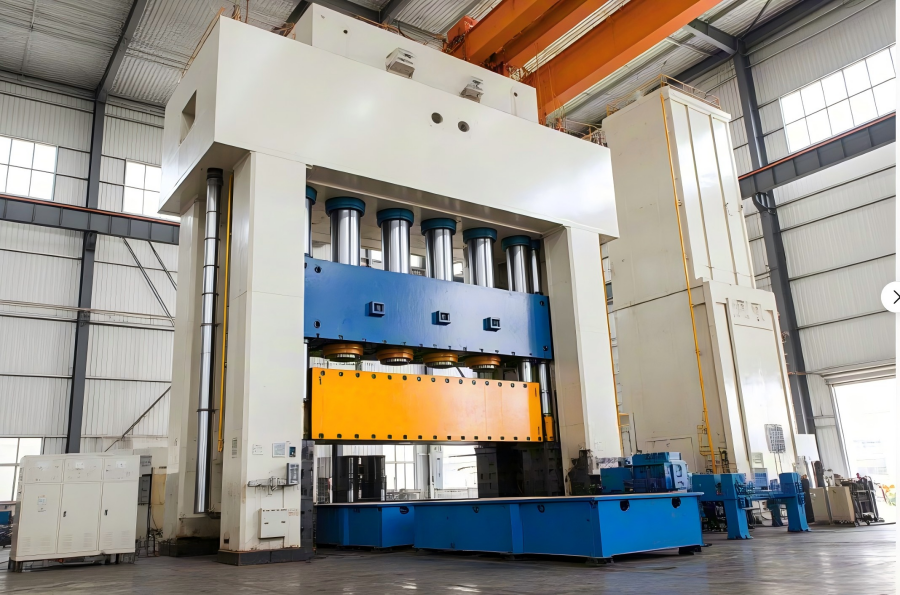
Equipment Photographs:
- 4,000-ton hydraulic forging press: Enables precise forming with large deformation amounts.
- Vacuum induction melting furnace: Ensures material purity.
- Coordinate measuring machine: Monitors dimensional accuracy in real time (±0.02mm).
-
Process Flow:
Raw material inspection → Vacuum melting → Forging → Heat treatment → Machining → Non-destructive testing → Extreme environment testing
Stepwise Testing and Process Iteration
- Testing Phase 1: Basic strength verification (room-temperature tensile and hardness tests).
- Testing Phase 2: Extreme temperature cyclic tests (-40°C freeze cracking test, 150°C high-temperature creep test).
- Testing Phase 3: Long-term corrosion resistance test (1,000-hour salt spray test).
- Results: After three rounds of process iteration, the optimal parameters of a heating temperature of 1,150°C and a deformation amount of 30% are determined, increasing the yield rate from 72% to 91%.
V. Delivery Outcomes and Customer Value
Output Forms
- Process Documentation Package: Includes forging process cards, heat treatment curves, and quality inspection standards (e.g., ASTM E8 standard).
- Test Reports: Contain 120 sets of experimental data and failure analysis spectra.
- Animation Demonstration: 3D visualization of the process flow for customer training and production replication.
Customer Benefits
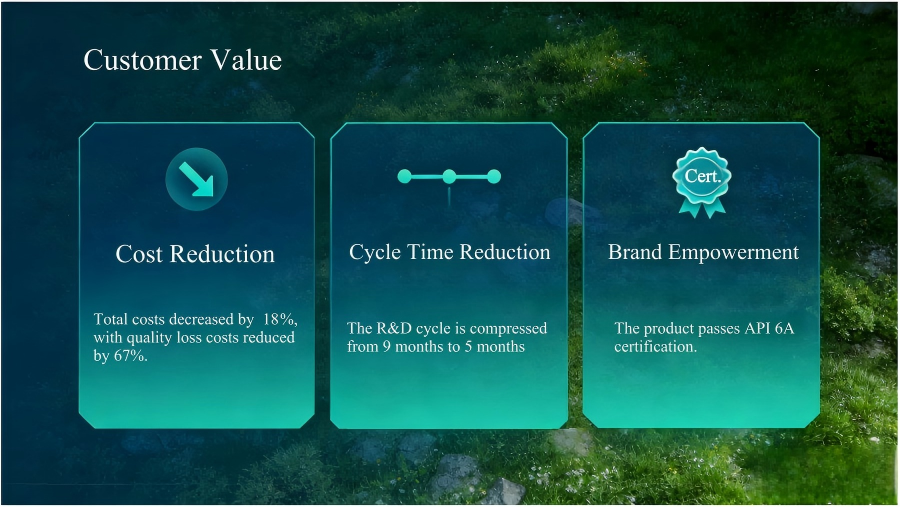
- Cost Reduction: Total costs decreased by 18%, with quality loss costs reduced by 67%.
- Cycle time reduction: The R&D cycle is compressed from 9 months to 5 months, enabling our customer to seize market opportunities.
- Brand Empowerment: The product passes API 6A certification, helping the customer secure a high-end energy project bid in the Middle East.
Please check the article: TBC-TS-002