Industry Background
As China's mold industry is at the critical juncture of transforming into high-end, the demands for mold precision, longevity, and complexity in sectors such as new energy vehicles, aerospace, and consumer electronics have been continuously rising.Taking new energy vehicles as an example, there is a soaring demand for molds for large integrated structural components like battery boxes and motor housing. However, the issues of long development cycles and high trial-and-error costs associated with traditional mold development are becoming increasingly prominent.
Customer Pain Points and R&D Challenges
Traditional mold development faces three core pain points:
- Long development cycles: It takes 6 to 12 months from design to mass production, involving multiple rounds of mold trial corrections.
- Precision bottlenecks: Because of the experience-based tolerance control of complex curved surface molds, the molds are prone to defects like shrinkage porosity and deformation.
- Uncontrolled costs: With each mold trial costing up to tens of thousands of yuan, the cumulative effect of numerous iterations leads to a dramatic increase in the total expenses.
Advantages and Solutions of Reverse Modeling Technology
3D reverse modeling achieves cost reduction and efficiency improvement in mold development through a closed-loop process of "physical object - data - model":
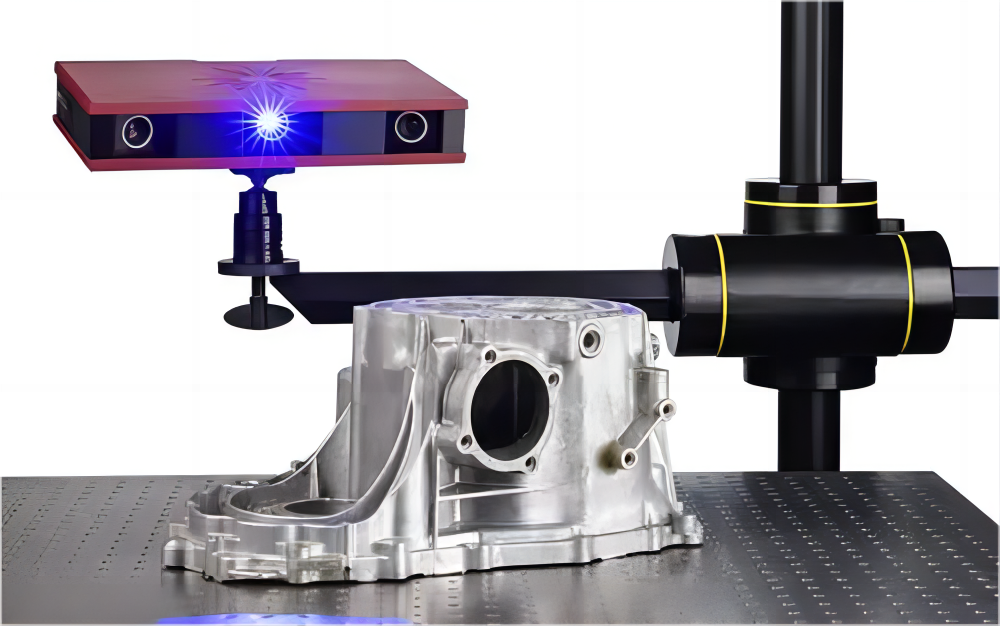
- Precision leap: By integrating ATOS blue-light laser scanning (0.01 mm resolution) with Geomagic Design X-based surface reconstruction, we achieve 98.74% conformity between the model and point cloud data.
- Lead Time Reduction: In the mold development for an aluminum alloy signal amplifier housing, reverse modeling compressed the full workflow—data acquisition, model reconstruction, and die-casting analysis—to just 15 days, a 60% reduction versus traditional methods.
- Proactive risk management: to verify design rationality by using rapid prototyping. For instance, in a car mold project, a design defect in the sealing groove was identified in advance, avoiding the scrapping of a mold worth 500,000 RMB.
One-Stop Development Service Process and Guarantees
Professional service providers offer a comprehensive solution throughout the entire process:
- Demand diagnosis: Build a multidisciplinary team (comprising material engineers, mold designers, and reverse modeling experts) to conduct process feasibility analysis.
- Data collection: Select laser/structured light/CT scanning technologies based on the characteristics of the object. For example, use imaging agents for pre-treatment of highly reflective surfaces.
- Model reconstruction: Adopt the four-step method of "zoning - positioning - sketching - stretching" to ensure G2 continuity of the curved surfaces.
- Process verification: Combine Magma casting simulation software for filling and solidification analysis to optimize the gating system design.
Technological Evolution Trends
Amid the wave of manufacturing transformation and upgrading, 3D reverse modeling has evolved from an "optional tool" to a "core capability." Technological innovation brings not only efficiency improvements but also serves as a key path for China's mold industry to break through international technical barriers.